Favorite Quotes: Einstein on Compound Interest, the Eighth Wonder of the World
I came across a quote today that immediately went on my list of favorites. It sums up in two sentences why I think compounding interest is the most important idea in investing.
“Compound interest is the eighth wonder of the world. He who understands it, earns it … he who doesn’t … pays it.” – Albert Einstein
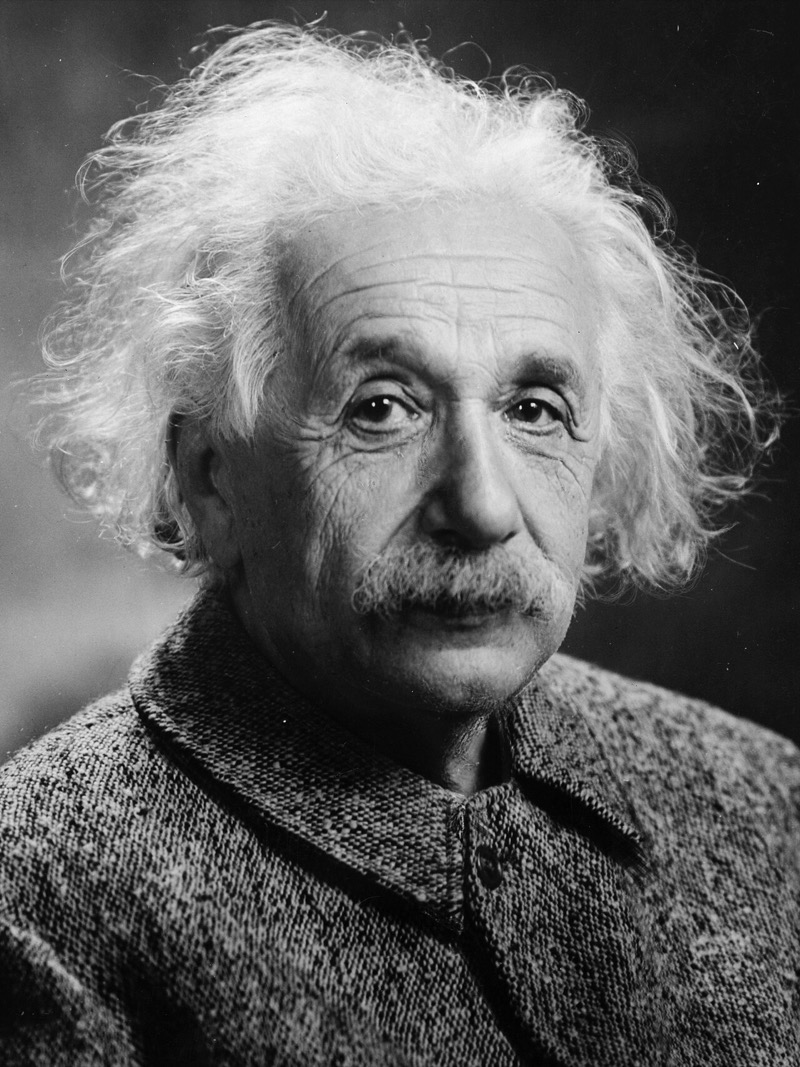
Albert Einstein in 1947. Photograph by Orren Jack Turner, Library of Congress (public domain).
I was curious about where this quote came from and what Einstein was talking about when he said it, so I went digging. What I found surprised me.
Did Einstein really say it?
Almost certainly not.
The researchers at Quote Investigator have traced this saying back through decades of newspapers, and Einstein doesn’t show up until long after he died in 1955. Here is the short version of the history they found:
- 1925 – The earliest known appearance is an advertisement for The Equity Savings & Loan Company in the Cleveland Plain Dealer: “The Eighth Wonder of the World—is compound interest.” Nobody is credited. It was most likely written by an anonymous advertising copywriter.
- 1965 – A savings and loan ad in the Wall Street Journal gives the line to Baron Rothschild.
- 1967 – The economist Paul Samuelson writes about “what has been called the eighth wonder of the world—compound interest” without naming anyone.
- 1981 – A newspaper column credits “Old Grandpa Rockerfeller”, meaning John D. Rockefeller.
- 1988 – The first known attribution to Albert Einstein, 33 years after his death.
There is a sister quote, “compound interest is man’s greatest invention”, with a similar story. It started in a 1916 advertisement and was first tied to Einstein in a 1976 Wall Street Journal article, and even that article only said he was “reported to have said” it.
Princeton University Press publishes The Ultimate Quotable Einstein, and it lists this saying in a section called “Probably Not By Einstein”.
The second half of the quote, “he who understands it, earns it; he who doesn’t, pays it”, isn’t in any of those early versions at all. It looks like an even later addition.
So what was Einstein referring to? Nothing, as far as anyone can tell. The saying started life as an advertising slogan for a savings bank, and over the years it got attached to whoever sounded most impressive: a banker, then an oil tycoon, then the most famous genius of the 20th century.
I still love the quote. I’ll just be honest that the best label for it is “attributed to Albert Einstein”. The math behind it doesn’t need a famous name to be true.
The idea is much older than the quote
Compound interest itself is ancient. Old Babylonian clay tablets from nearly 4,000 years ago include math problems asking how long it takes a loan to double when the interest is added back to the principal.
In 1683 the Swiss mathematician Jacob Bernoulli asked what happens if you compound more and more often: yearly, monthly, daily, every instant. The answer he found is the number e (about 2.718), one of the most important constants in all of mathematics. So a real mathematical wonder did come out of studying compound interest. It just wasn’t Einstein who found it.
An example: the early bird and the late starter
In The Power of Compounding Interest I showed how a single $1 grows at 5% over 50 years. In Saving Money: Cutting the Cord of Cable TV and How to Create a Budget I looked at saving a little money every year and investing it.
Here is a different example. It is about when you invest, not how much.
Meet two friends, Erin and Lee. Both invest $5,000 a year and both earn the same 7% a year.
- Erin, the early bird, invests $5,000 a year from age 25 to 34. That’s 10 years and $50,000 in total. Then she stops and never adds another dollar.
- Lee, the late starter, waits until age 35, then invests $5,000 a year every year until 64. That’s 30 years and $150,000 in total.
Lee put in three times as much money as Erin. Who has more at age 65?
| At age | Erin (invested $50,000) | Lee (invested $150,000) |
|---|---|---|
| 35 | $73,918 | $0 |
| 45 | $145,408 | $73,918 |
| 55 | $286,039 | $219,326 |
| 65 | $562,683 | $505,365 |
Erin wins, by more than $57,000, even though she invested $100,000 less and stopped 30 years earlier. Lee never catches up.
Important: Erin’s extra 10 years of compounding were worth more than Lee’s extra $100,000 of savings.
(The 7% is a round number I picked to keep the math easy. Real investments don’t pay the same return every year, and nothing is guaranteed.)
Four ways to look at it
People learn in different ways, so here is the same example from a few different angles.
1. The numbers: who did the work?
Of Erin’s $562,683, only $50,000 is money she put in. The other $512,683 is interest, and interest on that interest. About 91 cents of every dollar she ends up with was earned by her money, not by her.
For Lee it’s $150,000 put in and $355,365 of growth. That’s still a great result, but Lee had to do three times the saving to end up with less.
2. The shortcut: the Rule of 72
Divide 72 by your interest rate and you get roughly how many years it takes your money to double. At 7%, that is 72 ÷ 7, or a little over 10 years.
Now look at Erin’s column in the table again. It doubles every decade: about $74,000, then $145,000, then $286,000, then $563,000. From age 35 to 65 she gets three doublings, and Lee, starting 10 years later, misses out on the last one.
That last doubling is always the biggest. Almost half of Erin’s final balance arrived in the last 10 years.
3. The picture: a snowball
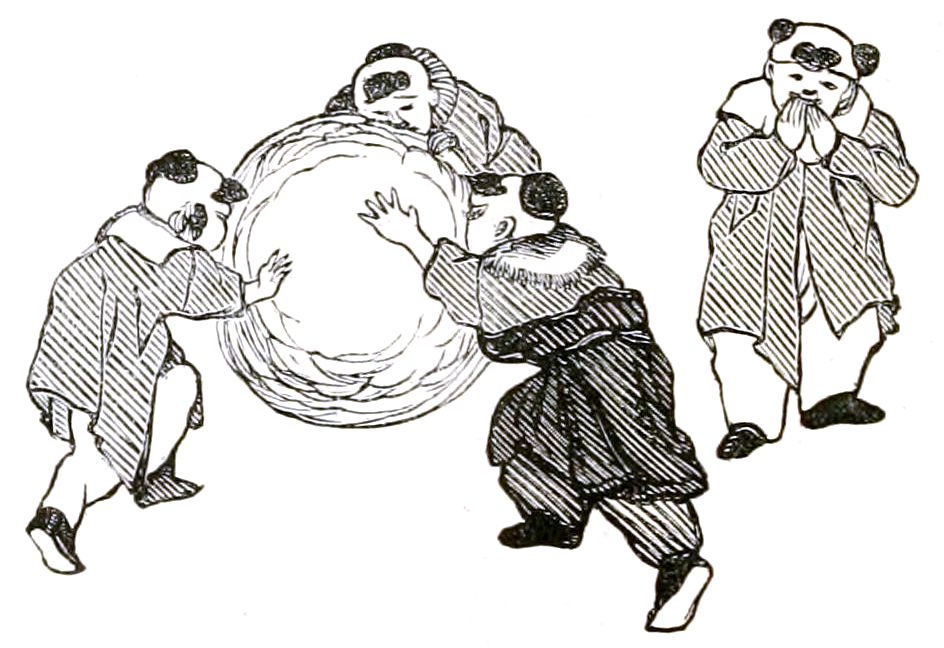
“Boys rolling a snowball”, a woodcut from the magazine Once a Week, 1860 (public domain).
Roll a snowball across the yard. Each turn picks up a new layer of snow, and because the ball is now bigger, the next turn picks up even more. Nobody is pushing any harder. The ball is just bigger.
Erin made her snowball early and then let it roll down a very long hill. Lee kept packing on fresh snow by hand for 30 years but had a shorter hill. When it comes to compounding, the length of the hill matters more than the size of the first snowball.
Here is what that looks like as a chart:
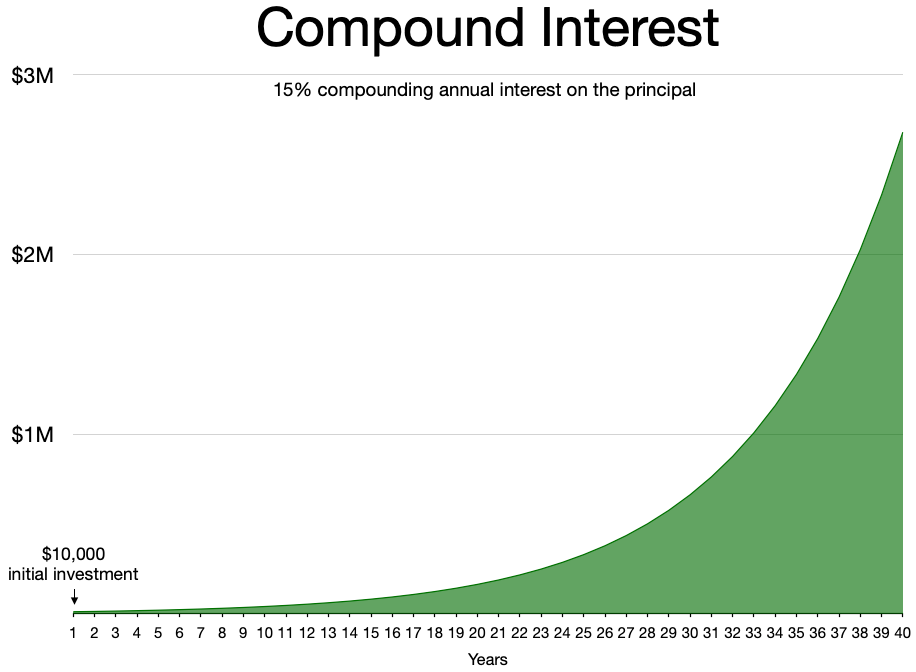
$10,000 compounding for 40 years. Chart by Wikideas1 on Wikimedia Commons (CC0). It uses a 15% return, which is far higher than anyone should plan on, but the shape is what matters.
Every compounding curve has this shape, whatever the interest rate: nearly flat for years, then a bend, then steep. Most people give up during the flat part.
4. The flip side: “he who doesn’t, pays it”
This is the half of the quote that most people skip over. Compound interest doesn’t care which side of it you are on.
Say you have a $5,000 balance on a credit card charging 22% interest, and you pay $100 a month.
- It takes 11 years and 5 months to pay off.
- You pay $13,678 in total.
- $8,678 of that is interest, on a $5,000 debt.
This is the same math that made Erin rich, but here the bank is the one earning the interest and you are the one paying it.
Takeaway: pay off high-interest debt first. Very few investments reliably earn 22% a year, but paying off a 22% credit card does.
What this quote means to me
I think this is why the quote has lasted for a hundred years, no matter whose name is on it. In one sentence it tells you there are two sides to compound interest, and that you get to choose which side you are on.
It also goes well with another of my favorite quotes, the Chinese proverb on the best time to plant a tree. The best time to start was when Erin did, and the second best time is now. Lee started late and still ended up with over half a million dollars.
If you’d like to see the formulas and more graphs, read The Power of Compounding Interest.